
The Children’s Guild: Culture Card – Part I
It is without any hesitation that I say the President & CEO of The Children’s Guild, Dr. Andy Ross, is a pioneer in the ‘workplace culture’ space. This past fall, I was able to shadow him for a full day, visiting numerous Children’s Guild sites, witnessing the power of a unified vision and aligned culture. I truly felt like the grasshopper absorbing and learning from a Culture Master!
We started our day at The Monarch Academy, a public charter school in Glen Burnie, where I had the pleasure of seeing some of Dr. Ross’ vision in action. At first glance, it’s clear this is not like most schools. The walls are vibrant and engaging, the teachers are introspective and the classrooms are alive – literally with animals across the species spectrum. It was the type of place any child would easily become memorized. I fell in love with the place in minutes, simply from the artistic joy that was being translated through my eyes.
As Dr. Ross states, “When our students come into a space, they see right away what we think of them. That’s why we put so much thought into making our environment vibrant and engaging. We want this place to be somewhere that they’re proud to be. You can’t feel that way when your desks are falling apart and the walls are bare. The space itself is a message that tells our kids that we care about them and they deserve it.”
It was apparent how seriously his team takes that sentiment. Each and every site I visited was filled with physical beauty and was clearly thought out with care. As I took in the sites on every wall and classroom, we finally landed in the Cafeteria for their daily routine, a Culture Card Meeting.
Many years ago, Andy and team had invested some serious energy into distilling their culture into values, purpose, principles, mission, vision and expectations. It’s exhausting just to list them all here now! But somehow they were able to tie it all together nicely in a beautiful pocket-sized card – their Culture Card.
I asked, How did the culture card come about?
“We had a consultant come in and they told us about The Ritz-Carlton hotel chain. Since they’re all over the world they had to do something to make a consistent experience no matter where you visited. So if you wanted a down feather pillow, there is a message that would pop up in their service department that would say, “MaryBeth would like a feather pillow”. So it’s consistent no matter if you’re Hong Kong or Baltimore.
So we really liked that idea and went to see their culture meetings. They happen every day at the beginning of every shift. That’s where we got the idea for the Culture Card. We saw that it worked and we knew it would support the consistent experience we wanted to create every day in our work.”
What was the process of creating the content of the culture card?
“That came from really understanding what happens in a children’s organization. We have kids who are traumatized and have behavior issues from that trauma. We’d see what would happen, every day and we’d see what was consistent. That’s when we started to write it all down. We saw the trends and we built on them to own them as a part of our culture – not try to push them away.
People think that if you educate people then everything will just go right. And that’s just not how it works. You’re on a journey. You might be headed in that direction, but it’s like bumper cars. You can be bumped and it takes you down a different road. Our culture card had to be a true reflection of our journey.”
As I stepped into this Culture Card meeting, I knew how critical it was to bringing their values to life. Like the culture nerd that I am, I was stoked to see it in action!
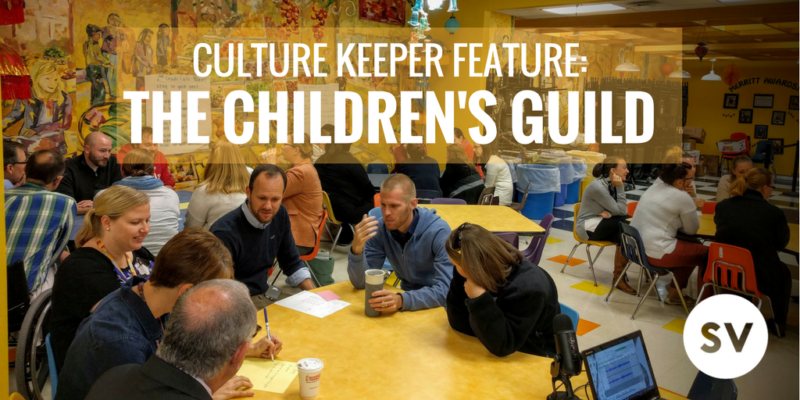
All the teachers were gathered in a circle and the principal states, “Chaos is ever present in a child-serving organization. The key to managing chaos is to embrace it, not fight it. As we know one of the most chaotic times is in the morning when you walk in. The Culture Card is one of the best ways to start thinking about this. So now, we’re going to create norms around embracing that morning chaos.”
Groups gathered around tables, lively chatter ensured and some really practical ideas were shared:
- Smiles are free
- Make your words count. Brief = awesome
- Pssst – pass it on to those who missed it
- Be on time – you can usually control that
It was a quick, 10 minute or less exercise that brought everyone together to connect about their culture and how to work through the realities of everyday challenges – opposed to trying to change the reality.
These meetings happen at the beginning of every shift, every day, at every site. One of the most beautiful statements came from the executive team meeting later that day when someone said, “Chaos is just transportation to a better place.”
I don’t know about you, but that statement surely got me feeling more ready to embrace the chaos in my life.
While the process of creating a Culture Card takes introspection and time, it means nothing if you’re not investing in bringing that to life every day. It’s like having beautiful Value Statement posted plastered all over your walls, but no one is experiencing those values. You may as well toss your resources down the toilet if you just want pretty value statements and no accountability to experiencing them.
For example: Say, “Trust” is a stated workplace value, but employees have to go through metal detectors to get into their building. Talk about a mixed message! Perhaps “Safety” is actually the more accurate value in this example. Organizations need to spend the time to ensure these statements are aligned.
It was a gift to see an organization who’s bringing their investment in their culture to life every single day. And while it’s not perfect (Andy said so himself) it’s their journey. And they’re moving towards innovation and a better place every single day with their Culture Card meetings.
How does your organization invest in identifying, owning and bringing life to its values and culture?
The “Culture Keeper Feature” blog series highlights individuals and companies who are leading the way in crafting healthy, intentional and authentic workplace cultures. “Culture Keeper” is a SparkVision term used to describe the people who lead and maintain the positive aspects of their organization’s environment & values.
Stay tuned for Part 2 of this Culture Keeper Feature where we dive into the 5 Pillars of Every Organization – another Dr. Ross signature concept.