
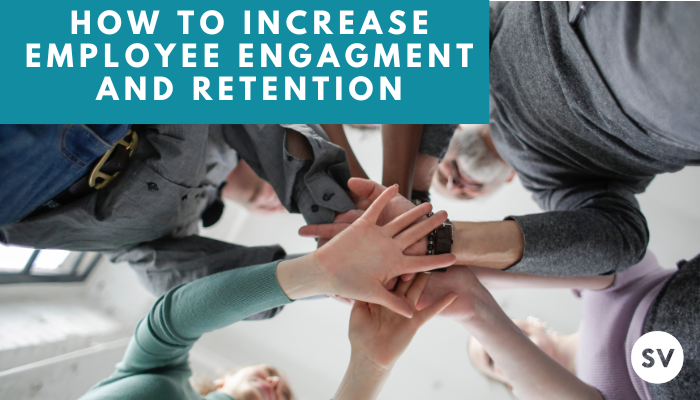
Improve Retention and Engagement at Work through Core Values
Your values can absolutely (and, in my humble opinion, should) be the way that people feel engaged and, therefore, stay committed in their roles. But how many organizations harness core values in that way? This is a missing ingredient for many companies trying to boost employee engagement and retention.
Employee engagement and retention are the emotional commitment the person has to the organization and its goals. This emotional commitment means that engaged employees care about their work and their company. They don’t work just for a paycheck or just for the next promotion but on behalf of the organization’s goals. When employees care—when they are engaged—they will go above the minimum requirements to see something through and do the right thing.34 Remember all those stats on the effect of employee engagement on your bottom line? How can you make sure that your company’s practices are aligned with your values when it comes to employee engagement and retention?
Employee Engagement and Retention Tip: Be clear to be transparent.
Transparency is a transformative value in itself. It’s closely aligned with trust, connection, and communication. As Brené Brown says in Dare to Lead,
Clear is kind. Unclear is unkind. I first heard this saying two decades ago in a twelve-step meeting, but I was on slogan overload at the time and didn’t even think about it again until I saw the data about how most of us avoid clarity because we tell ourselves that we’re being kind, when what we’re actually doing is being unkind and unfair. Feeding people half-truths or bullshit to make them feel better (which is almost always about making ourselves feel more comfortable) is unkind. Not getting clear with a colleague about your expectations because it feels too hard, yet holding them accountable or blaming them for not delivering is unkind. Talking about people rather than to them is unkind.35
Employee Engagement and Retention Tip: Respond to emails.
I wish I didn’t feel the need to even write this section, but I do. So many executives are so inundated with emails that they get lost, fall to the wayside, and are never addressed. This means that it’s time to hire administrative support to ensure that you can reply to emails in a timely and thoughtful fashion. It’s frustrating and damaging to team members when they have to hunt you down to get a response. And if you’re avoiding the email because you don’t feel like dealing with it, you’re perpetuating that attitude with other team members.
Even if you need to politely decline or delegate the responsibility of the next steps around the email to someone else, do it with integrity. Don’t just hope that person forgets or that they will stop bothering you if you don’t get back to them. Treat your team members with the same response time and clarity that you desire to be a cultural norm. And while you’re at it, perhaps you want to see which values and their promises you might be breaking by not responding to your emails.
Employee Engagement and Retention Tip: Involve more people in decision-making.
It’s always a good idea to ignite opportunities for feedback and buy-in. What approach are you taking with decision-making? Are you engaging people who will be affected by the decision or making a choice based on your personal preferences? Are you using your values filter or creating your own system?
Employee Engagement and Retention Tip: Respect time off.
This can be one of the trickiest points of all, given our societal norms of go-go-go and always being on. Although the internet has brought us game-changing innovations, it’s also steamrolled a lot of boundaries for people and negatively influenced their relationship to their own inner harmony, well-being, and balance.
As a leader within an organization, you are constantly sending messages to your team about what’s expected through your own behavior. If you’re emailing people over the weekend, you create an expectation that they will be checking and responding to you over the weekend. If you must send an email after hours, make sure that you tell people that you don’t expect them to respond (if you really don’t). The same goes for when you or your people are on vacation. Respect that time, and value it as what’s needed for your team member to be able to perform at high levels when they return.
In fact, according to Project: Time Off, the majority of working Americans reported the positive effects of taking vacation time and said the following about when they returned to work:
– Their mood was more positive (68 percent)
– They had more energy (66 percent) and motivation (57 percent)
– Felt less stressed (57 percent)
– Were more productive (58 percent)
– Their work quality was better (55 percent)36
Project: Time Off research also found the following:
– Employees who reported that their company encouraged vacation were much happier with their jobs (68 percent) than those who worked at places where either vacation was discouraged or managers were ambivalent about taking time off (42 percent).
– Employees were also more likely to use all their vacation time (77 percent compared to 51 percent).37
So please, take your lunch breaks, your nights, your weekends, your holidays, your paid time off. Leave by example. You are not alive so that you can work every moment of your life. If you embody the values of inner harmony, balance, family stability, or well-being, it will be much easier for team members to follow suit. End work on time, take vacations, and show up to important milestone moments outside of work, even if that means you take a day off. Demonstrate that everyone has the ability to choose by modeling that behavior.
Employee Engagement and Retention Tip: Volunteer together and apart.
Corporate social responsibility is becoming one of the more common values across the country. Having specific opportunities for your team to take on a volunteer project is one of the best ways to ignite teamwork and team building while simultaneously making an impact in your community. You can even amplify your own workplace values by partnering with a nonprofit that shares your values. This will give team members a whole new way of experiencing those shared values while making a new impact in their community.
Research has shown that volunteer programs improve employee satisfaction, foster employee engagement, and boost retention. For instance, the Macquarie Graduate School of Management found that 93 percent of employees who volunteered through their company reported being happy with their employer, and 54 percent of those who were proud of their company’s contributions to society were engaged at work.38
It’s also empowering to provide volunteer hours for your team members to use as they desire. When I was a fundraiser at a nonprofit, we had a bucket of volunteer hours that we could use each quarter on our own time. It was fantastic because I was a big sister in the Big Brothers Big Sisters program, and there were often experiences that I wanted to support my little sister with that happened during work hours that I could now take advantage of with more grace. I found myself being incredibly grateful for that autonomy while also being celebrated and supported for my personal contributions.
So much so, in fact, that after a few years of being a big sister, my mentee unexpectedly became our foster daughter. It was an emergency situation, and my husband and I knew that we had to step up and have her in our lives in a more significant way. We both let our companies know, and they were fully supportive. To the point that the CEO of my company pulled me aside and said, “I heard what’s going on now, and I want you to know that you have full permission and support to do whatever you need anytime you need to for her. Know that we all trust and believe in you. Just let us know what you need, and you’ll get it.” In that one conversation, all my fears of volunteer hours running out melted away because he gave me full permission to be human.
Employee Engagement and Retention Tip: Invest in team building.
Much like volunteerism, investing in time for people to be social and to get to know one another has staggering returns. When you know people for more than just their job title and responsibilities, you organically become more invested in them. This doesn’t need to consist of some kind of huge event (although I’m a massive proponent of retreats); it can also be little moments that are integrated into your regular ongoing operations.
I worked with a company that began a new way of connecting while everyone was remote during the pandemic. Each morning they have an all-staff check-in call, and they kick it off by having one person share a fun fact about themselves. It’s ranged from people sharing music talents, to the inner workings of their man caves, collections of memorabilia, and awards and trophies from the past.
The idea was to share something about themselves that their team members likely didn’t already know. Something that takes only a few minutes out of the agenda has had an incredible return for everyone on the line. Team members who had been working with each other for years felt more connection and commitment to one another than ever before because they understood who their team members were and what they had in common and appreciated what they had that was distinct. So many sparks went off that ignited more offline conversations as a result of simply asking people to share more of themselves within a specific framework.
Employee Engagement and Retention Tip: Be authentic.
This concept of authenticity is so overplayed right now, I know. But the reason we’re hearing everyone talk about it is because it’s completely connected to people’s well-being. We are our most authentic selves when our behaviors, actions, and experiences reflect our core values. That said, being authentic can also sometimes become an excuse for bad behavior.
Bob Burg, Hall of Fame Keynote Speaker and coauthor of The Go-Giver, a book about changing the focus of success from getting to giving in business, posted the following on his LinkedIn account:
Authenticity should never be used as an excuse. Like the person who says, “I have anger issues and I yell at people a lot. If I were to stop doing that it wouldn’t be authentic of me.”
Baloney! It simply means (s)he has an *authentic problem* that (s)he needs to authentically overcome in order to become a better, higher, and more effective authentic version of herself/himself.
In other words, rather than using authenticity as a reason or excuse to stagnate and not improve, use it as motivation to propel you to grow; to step up into your true, much more effective, and higher version of your authentic self.39
Employee Engagement and Retention Tip: Encourage collaboration.
When people can collaborate in a healthy and productive way, it creates a lightened load for everyone and brings in some of the best innovation you could imagine. That old expression “Two heads are better than one” is almost always true. When people collaborate, something bigger than themselves emerges.
Keep in mind that not everyone likes to collaborate. Although that’s not an excuse, it’s an opportunity to be more thoughtful about what collaboration could look like. Perhaps someone really dislikes the brainstorming process but deeply enjoys the finishing touches. Bring them in when it’s time for them to shine in the collaborative process instead of forcing everyone to be involved in every detail of a collaboration.
Diversity of thought and perspective are so important in the collaborative experience. Diversity comes from so many factors such as race, religion, generation, gender, sexual orientation, ability, economic, neurodiversity, cognitive, and experiential, to name a few. When you have a diverse team, you have a wealth of varied life experiences, which causes individuals to approach problems differently and to empathize differently. So many more people can be touched, served, and moved when you engage in diverse thinking instead of just a like-minded approach.
Employee Engagement and Retention Tip: Mentor.
Mentoring is one of the best ways for your team members to feel valued and supported at work. Loyalty, engagement, and retention of team members are often increased a great deal when people have a genuine mentor at work. Keep that word genuine in mind when you look at the mentoring relationships (or lack thereof) in your office. I’ve worked with companies that had a forced mentoring program in which people were required to meet with someone more senior than them at least once a month in order to gain mentorship. Although in theory that’s an awesome idea, many of the mentees felt overlooked and unimportant after their mentors regularly canceled, no-showed, or rescheduled at the last minute. Then once they did meet, the mentor was not engaged or actively interested in their mentee’s needs.
This example could go the other way too. I’ve been an assigned mentor to someone who did not seem interested in being mentored by me. It felt like she was mostly coming for the meal I was treating her to and completely relied on me to carry and engage in conversation. That can be an unrewarding situation for both sides.
Employee Engagement and Retention Tip: Consider values mentors.
This would completely negate the belief that a mentor is someone with a certain title or credential, shifting focus to the fact that they have mastered the embodiment of a certain value and that they are open and willing to share their wisdom with others who want to grow in that area. This can be very similar to one-on-one coaching.
For example, when a graduate student asked me to be his mentor, we spent time defining and understanding what success would look like for each of us. We then went into understanding the values he wanted to strengthen in his life and compared them to the values that I felt I had reached authentic embodiment of.
Then, I looked to him to see which values he had embodied that I wanted to strengthen. We landed on my mentorship of the value of inner harmony and his mentorship on the value of adventure. Every time we got together, this was the frame for our conversations. We’d discuss whether our latest experiences were in or out of alignment with our stated values and celebrate and provide wisdom to the other whenever appropriate. It made the typical mentoring experience so much more dynamic and personalized. We cut through the BS and went straight to the good stuff.
This approach may or may not be exciting to others. As with any coaching or mentoring relationship, you want to be sure that there are clear expectations on the front end that you have agreed on so that you can be sure to meet each other’s needs.
Employee Engagement and Retention Tip: Help them understand how they’re making the vision a reality.
When you can connect the dots to the bigger picture, people have a sense of purpose and meaning. Whether you’re the person who’s emptying the trash bins or the person who’s executing the largest projects, each of your team members deserves to know how their piece of the work is adding to the bigger picture. Check out Start with Why, by Simon Sinek, if you want to dive more deeply into this topic.40
Employee Engagement and Retention Tip: Give permission to be human.
If someone is disengaged and/or seems like they’re reaching a breaking point in terms of continuing as a part of the team, it’s time to have one of those honest conversations. Start with your intention and then ask them what’s been going on and what you can do to support them. Most of the time, there’s something you can do about it, but sometimes there really isn’t. Don’t make false promises but rather look at what’s in the best interests of that individual and support them accordingly.
Are you looking to have a more engaged workforce who wants to stick around for the long term?
This was an excerpt from MaryBeth’s book – Permission to Be Human: The Conscious Leaders Guide to Creating a Values-Driven Culture.
Learn more from this company culture book.
34 Kevin Kruse, “What Is Employee Engagement?” Forbes, June 22, 2012,
35 Brené Brown, Dare to Lead: Brave Work. Tough Conversations. Whole Hearts.(New York: Random House, 2018),
36 American Psychological Association Center for Organizational Excellence, “2018 Work and Well-Being Survey,” American Psychological Association, June 2018,
37 Ibid.
38 Lina Caneva, “Corporate Volunteering Improves Employee Engagement—Study,” Pro Bono News, September 24, 2013,
39 Bob Burg, LinkedIn, 2020
40 Simon Sinek, Start with Why: How Great Leaders Inspire Everyone to Take Action (New York: Penguin Group, 2009).