Those who make you feel warm and fuzzy, and those whom you avoid like the plague.
When I started my company, I found that it was harder than I realized to translate workplace culture into phrasing that was both productive and relatable. Without a doubt there is a solid learning curve separating those who get the distinct language associated with the emotional intelligence side of culture and those who do not. In other words, you either speak that language or you don’t. Only those who care to build on or learn this vocabulary will be successful in the long game of culture.
After just a few weeks of being in business (and the need for my services not being clear to my audience), I knew I had to create my own terminology, one that wouldn’t require a ten-minute explanation, something that would make sense no matter whom I was talking to. Enter two big players for describing people in the workforce: culture keepers and culture killers.
Without any description, you probably have a solid idea of who I’m talking about, right? Those who make you feel warm and fuzzy, and those whom you avoid like the plague. We have all experienced both—and we all know whom we prefer to surround ourselves with.
Culture keepers are the individuals who lead and maintain the positive aspects of their organization’s environment, a reflection of the company’s core values.
They are often at the center of positive work experiences. These team members typically have high emotional intelligence. They can be new hires or lifers—tenure doesn’t determine their reach. They authentically bring their personality and ideals into daily engagements. They’re not perfect, so when they make mistakes, they own them and grow as a result. They don’t focus only on their needs but also on what’s right for the team. They’re the ones who care more about their people than just about meeting a deadline. They are the ones we often want to spend time with. We want to be around them because they’re always helping us to see the potential in everything.
Culture keepers are the folks who other team members look forward to collaborating with. They ask you how you are doing and really want to know the answer. They listen for when you might be struggling on a project and unconditionally jump in to help. Others often confide in them, and they can raise the bar from the sincerity and authenticity with which they carry themselves. This doesn’t mean that all these folks are playing an extroverted cheerleader kind of role; you can do that and be a very quiet person, simply by the way you behave. Culture keepers are the ones who hold up the positive aspects of a company’s daily norms. Most of the time, that is just who they are. They don’t act this way because of an incentive program or special training. These are people who want to do good work and be good people while doing it.
Leadership within organizations should be working hard to nurture their culture keepers’ talents and to retain them as long as possible—because they are doing so much more than just their jobs when it comes to maintaining healthy energy in their space.
Culture killers, on the other hand, are the people who are both actively and passively taking away from a positive work experience.
And sadly, these folks have the power to take down a whole team of culture keepers. Companies often want to hire me to come in and “fix their culture issue” without addressing the person or the people who are creating it; they want to make a workaround. And that’s not how it happens. It’s like expecting someone to just learn how to be a better swimmer while having a ball and chain attached to their leg.
These culture killers are the people who always point out something that is wrong, and when new ideas arise, their response is, “Yes, but…” They are often found spreading rumors in the break room and using gossip as a form of currency. They have a bad day and think it is perfectly acceptable to take it out on others. They have little to no self-awareness, and other team members practically hide from their path so that they do not get hit by their venom. And although it is not an excuse for their actions, culture killers are the humans who are suffering—how they act on the outside reflects what they feel on the inside.
Don’t be fooled: Often the biggest of the culture killers are those at the top. They have been in the organization so long that they feel they can get away with anything because they’re so “needed.” They can use an organization like their own game of chess and manipulate people in ways that result in the ultimate death of positivity.
Anywhere we go, we’re all just balls of energy. If our energy (through body language, speech, or behavior) signals to other people that they don’t belong, they’re less than, what they’re doing isn’t meaningful, or their opinions don’t matter, then we are choosing to be a culture killer. Some people feel that their way is the only way or maybe ignore you all the time, making you feel like you are never seen, heard, or listened to. Maybe the person is talking to everyone else about an issue they have with an individual instead of thoughtfully approaching people with whom they need to have hard conversations. These are all classic qualities of culture killers. Their energy kills the good vibes that were trying to survive in their workplace.
Plain and simple: Culture killers are values violators. When they’re not held accountable, the values mean nothing. In the words of Perry Belcher, “Nothing will kill a great employee faster than watching you tolerate a bad one.”
Your culture is only as strong as the worst behavior that is allowed, ignored, or gossiped about. If you want to truly live your values, you must be willing to terminate someone over behaviors that are out of alignment with your company’s core values. Otherwise, core values are just nice ideas that have no weight. When you get to that place, your values can work against you and become a point of profound frustration and anger for your team.
You see, culture is not one size fits all.
There are likely organizations that are much better equipped and designed to work with the person you need to let go of in order to protect your values. Letting someone go doesn’t need to be seen as this awful result. It’s helping both sides of the equation to step up more authentically regarding who they are and where they can make the biggest impact. I coached a CEO through major terminations of culture killers who were entrenched in her organization’s negative cultural norms. To empower her through the process, we framed the experience as liberating the team and those two leaders from being in an environment that wasn’t supporting their well-being. It was true for both sides of the equation.
I’m not suggesting that you terminate someone right off the bat. You need to give them a chance to be coached and held accountable. After they’re given that guidance and the space to make new choices, if they’re not on board to change and evolve, then it’s time to let them go so that they can find a culture that’s a better fit. It’s not fair for either of you to keep suffering at that point.
If it is acceptable for someone to go around talking badly about others while remaining unwilling to talk to those people directly or to berate people instead of coaching them…that’s as good as your culture is. You cannot excuse that and put blinders on because “they’re really great at sales.” Let me tell you, if you didn’t know already, people—your people—talk about these toxic people and experiences a lot.
The play-by-play recaps of those behaviors are being relived well past when they happened. The gossip ensues, and then that “isolated” experience is lived out in secondhand, thirdhand, fourthhand, and fifteenth-hand exposure in the storytelling of it. Because of our negativity bias, these stories stick harder than ones of celebration. Negativity bias is the notion that, even when of equal intensity, things of a more negative nature have a greater effect on one’s psychological state and processes than neutral or positive things.
How our minds love to cling to what’s wrong, bad, or a problem as opposed to what’s right, good, or possible.
Unfortunately, our brains are wired that way, and we have to do some serious reprogramming to change it. You know what I’m talking about, right? That annual review where you got high marks in every area but one, and instead of celebrating the nine positive areas, you beat yourself up for the one area you need to improve on? I used to do this a lot with feedback surveys. I’d get high marks across the board and then there would be one person who’d give me a low score and make a comment like, “She had no idea what she was talking about.” Instead of celebrating the 199 positive reviews, I’d just want to know who this one person was and how I could make things right with them. Looking back, I know what a silly use of energy that was.
Know who your culture keepers and culture killers are, and work with them to cultivate more or fewer of the behaviors that are or aren’t serving the energy you want to create in your workplace. At times leadership can be played, and some culture killers get away with bad behavior because leaders are blindsided or oblivious based on their firsthand experience. It’s important that there are safe and confidential spaces for team members to report these experiences to gain additional support in their growth. Whether it be through your HR team or via a more informal system, be sure that people can be heard and know that what they have to say matters. Nothing is worse than someone vulnerably sharing a traumatic experience at the hands of a culture killer and having it ignored. The worst kind of pain is getting hurt by the person you explained your pain to.
I often say that a company’s culture is simply its personality. These two main character types make a big impact on the overall collective personality of your team.
Here are a few qualities that lie at different ends of the spectrum for culture keepers and culture killers:
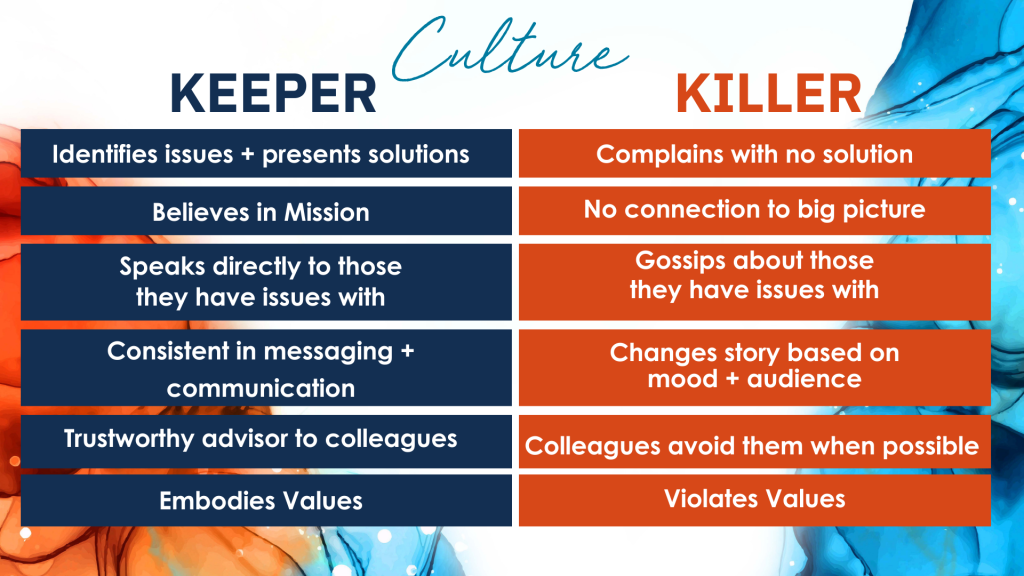
Look at this list; do you know where you fall? Culture Keeper or Culture Killer? Do you recognize the presence of these people in your organization? Could you make a list of names for both columns right now? I know that we all want to see ourselves as culture keepers and not culture killers, but it’s not always that cut and dried. Although it can be nice to put people into categories, it can also be dangerous to put hard labels on them. We want to use these concepts as a starting point, not as a way to judge and box people in.
This is an excerpt from MaryBeth’s new company culture book – Permission to Be Human: The Conscious Leaders Guide to Creating a Values-Driven Culture.
Want to learn how to create a thriving workplace culture in your organization and more about culture keepers and culture killers? Check out this company culture book today!