Understanding the Impact of Colorblindness in Society: Why ‘I Don’t See Color’ Matters
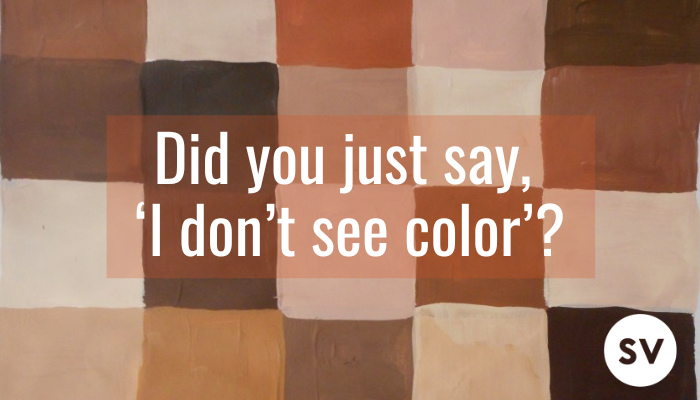
Whenever I hear someone say, “I don’t see color”, I cringe. I take a deep breath and begin to unpack, understand, and hopefully inform the person why NOT seeing color is a challenge for me to hear and can be offensive to others as well.
Recently I asked this question on my personal Facebook page and had nearly 50 comments on the topic. There were varying opinions, but these are the three commonly expressed themes.
1. Not seeing color erases history and context
Coley posted, “I think it is a subtle way of overlooking and downplaying one’s history and culture. It’s a diversity killer…”
Unfortunately, in many of my conversations, I come away with the sense that the history of People of Color is rarely taught or it’s glossed over in school. This lack of awareness creates a void of information and people who ‘don’t see color’ make the statement from a place of ignorance.
Also, without historical background, there is little to no context about how our issues today have evolved. For example, understanding how race came to be, helps us put things into context. Ta-Nehisi Coates said in his book ‘Between the World and Me,’ “But race is the child of racism, not the father. And the process of naming “the people” has never been a matter of genealogy and appearance so much as one of hierarchy.”
In short, the colors we associate with race were created to suppress one group over the other. To ease this fact doesn’t allow for an honest conversation on how to dismantle systematic racism.
2. Not seeing color discounts a Person of Color’s identity
Shareia posted, “To not see my color is to not see me. So, what’s next, you don’t see gender, ability/disability, etc? These identities make the person and to ‘not see it’ is offensive.”
As a Black man, the color of my skin is not something that I can take off, or change on a whim. Being Black is an experience, and for me carries the weight and responsibility of all those who came before me. To say you don’t see color says my hiSTORY is not valid. As Shereia mentions, it also begs to question what else are you neglecting to see?
3. You may not understand the privileges you are afforded
Carrie posted, “Privilege. It means color doesn’t impact your life so you don’t see how it could affect others.”
I heard the actor Mahershala Ali explain it this way, “People of color often have to go through life playing defense. We are on guard, looking for the moment when our life may be disrupted. Being on guard makes you aware that the world views you a certain way. In contrast, going through life playing offense means there is freedom to build and grow without restriction.”
When I hear someone make the statement, “I don’t see color,” a series of questions run through my mind.
· How do you identify yourself?
· Are you trying to be polite?
· What’s the problem with being a different race and culture?
I try not to ‘assume’ because I recognize that we are all on a journey, and some people are well-intentioned but also ill-informed.
So, if you are someone who has made the statement, here are three tips for self-reflection:
- Take some time to learn more about other racial groups. Look up how race came to be in the United States. Learning about Bacon’s Rebellion is a good starting point.
- Explore your own racial identity and what that means to you. If you need help in that area, you can seek out a coach, such as myself, to guide you through the process.
- Take a moment to be more aware, ask questions and listen to the experiences of People of Color.
Marjorie’s comment sums it up, “Nothing wrong with seeing color. It’s the treatment of People of Color that matters.”
If we are to move forward, we must see each other, not through colorless glasses but in full view with all the scrapes and bruises that accompany the experiences of people different than ourselves.
In a time when just about every aspect of our identity is politicized in some way, it’s necessary for each of us to affirm who we are while respecting the uniqueness of others.
Cory J. Anderson writes about practical ways to think about and implement equity, diversity, and inclusion in the workplace. He has always lived in a multicultural environment which he credits as his inspiration to bring diverse groups of people together. Cory is passionate about using facilitated conversations as a tool to increase understanding and personal development. He has held various leadership positions with several nonprofit organizations and universities facilitating multicultural education. He is the founder of Diverse Dialogues, an organization focused on breaking down barriers one conversation at a time. Follow him on Twitter @mrca12.