Here is help to make your company run smoother.
There are formal and informal systems and processes in every organization. Some make things run a lot smoother, and some create a bottleneck. These are often the areas of opportunity where people start to say things like this: “If it ain’t broke, don’t fix it.” “That’s too complicated; let’s not overthink it.” “That’s the way we’ve always done it.” “We tried, and that’s never worked for us before.” “I don’t have the time to overhaul that.” The reality is that if your culture really is out of alignment with your values, you haven’t tried it this way and you are constantly wasting time by not pausing to look at it and make better choices for your efficiency, productivity, and well-being. If you were to sift through each of these areas in your organization, I bet you’d find some gold.
- Set boundaries with your schedule. The way we spend our time is a direct reflection of the phrase “actions speak louder than words.” If you say that you want your people to have space to process, reflect, and grow, do your actions and schedules mirror that intention? I work with leaders all over the world and am constantly hearing about their jam-packed schedules, which often bleed into the evenings and weekends. They have a desperate desire to get a grip on their day-to-day flow but think that it comes with the territory of being a leader.
We often give our power over to what other people want from us instead of setting boundaries that help us ensure that we’re not constantly in a state of feeling overwhelmed.
As I’ve said before, the best thing any leader can do is to model the behavior they want to see in others. You want your team to be less stressed? Then show them what a schedule looks like for someone who isn’t constantly overwhelmed and who puts a stake in the ground with their boundaries. These can be simple adjustments or more complex analysis. You get to choose.
Here are some examples of schedule policies that I’ve created around our value of inner harmony:
- No external meetings on Mondays and Fridays.
- No more than three external meetings a day Tuesday through Thursday (a maximum of nine meetings per week).
- Determine a quitting time every day, and don’t work afterward.
I did this exercise with eight unique value statements, descriptions, and associated policies. I’ve blocked these out in my calendar and put reminders where I would most easily slip up. For example, on Mondays and Fridays, my schedule reads, “PROTECTED: Value Policy.” I’ve caught myself trying to sneak in an appointment on one of those days. Then that block shows up, and because of the language I used, it stops me in my tracks. If I had written “Hold” or “Do not book,” it wouldn’t have carried an ounce of the power that these words do for me. It also helps that my administrative assistant knows to never offer those days up for external meetings when she’s scheduling appointments.
If you wanted to take a more analytical approach, try color-coding your meetings. Start by thinking about the categories or types of meetings that you have on a regular basis and the percentage of your time that you want to dedicate to that category. Consider how that category relates to your core values. Then choose a color that represents those different types of meetings and begin to make a connection like the following:
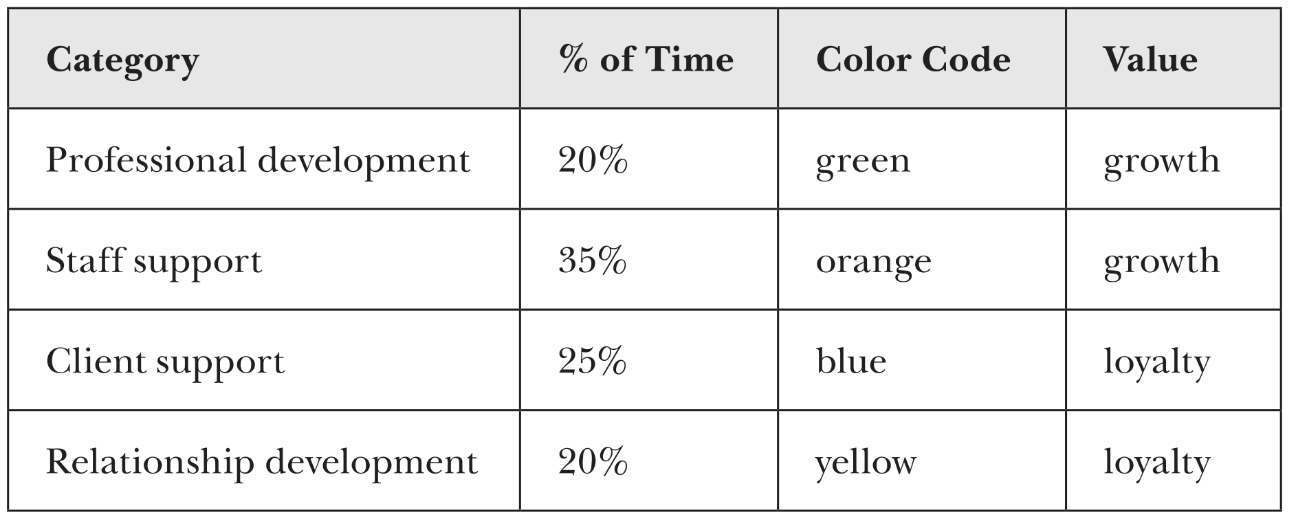
As you can see, I also added the value that was connected to that category of meetings. Looking at this list, would it feel in alignment with your intentions to have 55 percent of your time spent on growth and 45 percent of your time spent on loyalty? You get to decide and adjust your choices in how you invest your time accordingly.
Go through your schedule with your own color-coding system and update the meeting appointment colors. Finally, see if your intended percentages are an actual reflection of the time you’re spending on these items in reality.
If they’re out of alignment, start to time block your days and weeks to support your process to get back in sync. Perhaps you want to block entire days or weeks to certain aspects of work? When you time block your schedule to prioritize your values and those correlated actions, your life will change and you’ll give others permission to do the same.
- Make your out-of-office response human. I know that out-of-office messages can seem inconsequential, but every message we send (automated or handwritten) is an opportunity to ignite connection through our shared humanity. These autoresponders are created to set expectations and allow us to feel like we can step away without worry that someone may think we’re ignoring them. They are useful and necessary when it comes to workflow and boundaries.
Next time you have to alert people that you’ll be unavailable, consider sharing what you’re up to and how it activates your values. Instead of the classic “Sorry I missed you. I’m out of the office until [date], with limited access to email. If you require immediate assistance, please email […],” consider your version of an authentic approach.
Mine often reads like this: “Thank you for reaching out. I’m currently on retreat in the mountains of Idaho. I will be disconnected from technology to reconnect with my humanity over the next ten days. My values of reflection, unity with nature, and growth will be in full force. I hope you’re able to prioritize your values as a tool for well-being too.”
- Set realistic deadlines. Are your deadlines serving or hurting your team? A new CEO told me that she couldn’t believe what the people in her company had been doing to themselves before she took over. There were deadlines that were created for vanity metrics instead of for the capacity and ability of the team. Decades of these practices had led to the buildup and breakdown of mental health for her team members.
So many companies have massive year-end deadline processes. They ignite unnecessary levels of pressure and stress because they have come to believe that they’ll all turn into a pumpkin on midnight in the new year. All kidding aside, there are some legal reasons that you may need to do certain things before year-end; however, you likely don’t have to do everything at that same time.
- Develop a values-aligned strategic plan. So many teams go through an extensive strategic planning process every few years. And those very teams often miss the opportunity to incorporate their plans through the lens of their values. Whether you hire a consultant or make these plans internally, be sure that you start by reviewing your values and value promises so that they function as your compass and guardrails for your future plans and intentions. It can be as significant as entire initiatives based on your values, or it could simply be a callout box that highlights the values that are tied to the plans. As with the values filter questions from chapter 7, this is a perfect time to harness your values for genuine alignment as you build toward the future.
- Know your systems. The most common systems include payroll, personnel, accounts receivable, accounts payable, and inventory. Here are some general questions to ask yourself when looking at the effectiveness of your systems:
– How can we reduce the steps in this process?
– How can we combine steps to make the process simpler to follow?
– Can we repurpose an existing system or tool to save us time or give us a better result?
– How can we speed up this process or any step within this process?
– How can we automate this process (or any part of this process)?
– How can we semiautomate this process (or any part of this process)?
– How can we template this process (or any part of this process)?
– How can we lower the costs of completing this process without affecting the value of the output?
– What simple changes or improvements can we make to increase the value of the output?
– Who else in the world has a related process or tool that we can learn from to help us better design this process?48
– How can this process more effectively align with our values?
- Review operational processes. A business or operational process is an organized set of activities or tasks that produces a specific service or product. The process of providing a haircut, for example, often has three main parts: first hair washing, then the actual cutting, and finally styling with a brush and hair dryer. These processes are directly tied to how you generate income. So doesn’t that make them valuable?49
When looking at your operations through your values lens, consider if they are a true reflection or a nice idea that didn’t quite land. Let’s use the example of the hair salon and the values of collaboration, connection, and beauty. As you walk through the process of how someone gets their hair washed, does the customer experience collaboration, connection, and beauty? Perhaps another team member takes on this piece of the work with collaboration. Perhaps the conversation during the wash or even just asking whether the temperature is OK creates connection. Maybe the customer is treated with such kindness and support that they feel beautiful already.
Pretty simple. But the idea of updating and tweaking your processes by going on the customer’s journey will support your values and can run pretty deep. Asking your customers for feedback is an incredible way to amp up these processes too. Be direct. Ask, “How did you experience our values of connection, collaboration, and beauty? What’s one thing that we could do differently to better infuse our values into your experience here?”
- Review support processes. Aptly named, these are any systems that support the operational processes. This could include HR, financial management, building and property management, IT, security, corporate governance, quality management, and more. Using the salon example again, you might think about the processes around how to schedule an appointment, how you pay your bills, and whether the building itself is clean and equipped with the tools necessary to follow through on your services with ease and grace. Using the same values lens as before, it would be a fascinating filter to ask: Do these processes reflect collaboration, connection, and beauty?
- Review management processes. The management process begins with the three basic elements of this work: ideas, things, and people. Management of these three elements is directly related to conceptual thinking (of which planning is an essential part), administration, and leadership.50
Much of this was covered in chapter 7; however, I would be remiss in not including it here, in terms of how managers go about creating and adhering to their processes. In many cases, there is not a standardized process in these areas, but they could benefit from the creation of one. Other times, there are processes that are a total waste of time and that need to come to an end, such as weekly activity reports that are never reviewed or data entry of tasks that are never tracked. How might your management processes better reflect your values?
- Give permission to be human. Like culture, one system or process will not fit all. Recognize the nuances of leadership and learning styles, and try not to be too rigid. There is always opportunity to improve, so invite those possibilities in. It’s worth saying again: Avoid using phrases like “We’ve always done it that way” or “If it ain’t broke, don’t fix it.” These sayings shut down potential for innovation, connection, and a better way of solving problems.
Need help making your company run smoother?
This was an excerpt from MaryBeth’s book – Permission to Be Human: The Conscious Leaders Guide to Creating a Values-Driven Culture.
Learn more from this company culture book.
48 David Finkel, “10 Questions to Ask When You Design or Redesign a Process,” Inc., January 29, 2015
49 Knowledge@Wharton High School, “Operational Process,” University of Pennsylvania, February 28, 2011
50 R. Alec Mackenzie, “The Management Process in 3D,” Harvard Business Review, republished online from November 1969